Stereoscopic depth array
Paired optical sensors build a micron-accurate topographic map of the face — measuring relief, contour and symmetry before a single drop is released.
Six sensors, atomized airbrushing and adaptive gradient layering combine into one coordinated tabletop system — mapping, matching and rendering a complexion without human hand.
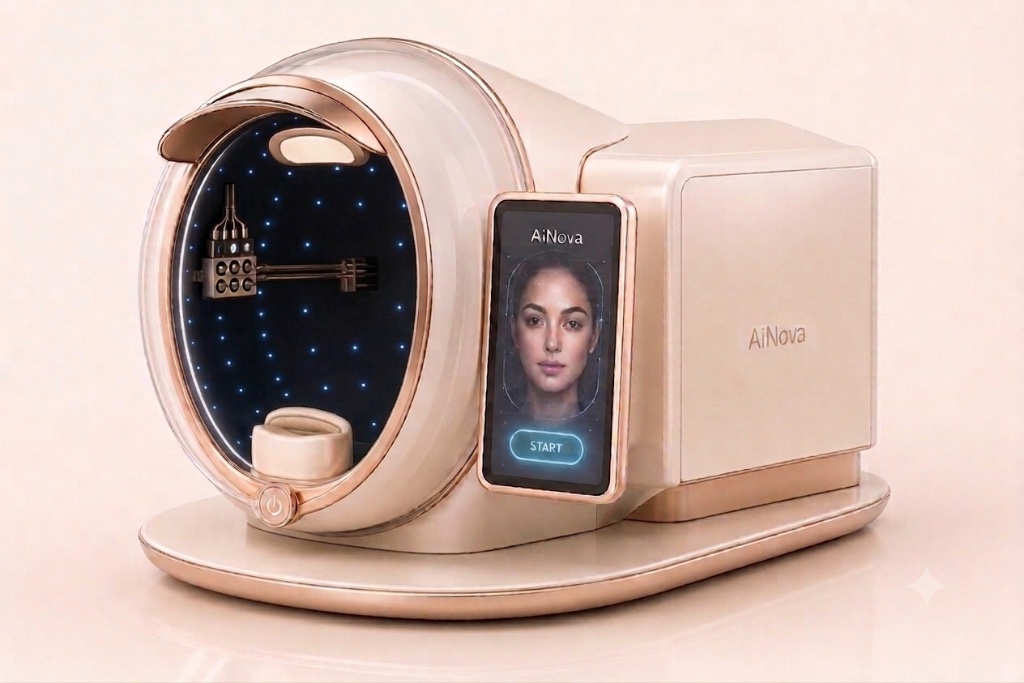
Paired optical sensors build a micron-accurate topographic map of the face — measuring relief, contour and symmetry before a single drop is released.
A multi-band spectrometer reads undertone and luminosity across the canvas to match pigment to skin with sub-shade precision.
Guided head alignment holds the subject within a controlled application envelope, keeping distance and angle constant on every pass.
A glass micro-nozzle deposits pigment in layers thinner than a human hair — weightless, transfer-proof, edge-free.
Calibrate — the array reads geometry, undertone and luminosity across the full canvas.
Compose — shade, coverage and intensity are selected and mapped to facial zones.
Apply — controlled micro-application places pigment in intended zones with repeatable precision.
Seal — the finished complexion is set for transfer-resistant, all-day wear.

